Hearing Wellness Journey Podcast
36- What Does My Hearing Test Mean?
Listen and Subscribe on Apple Podcasts
Listen and Subscribe on Spotify
#36: What Does My Hearing Test Mean?
SHOW NOTES
Hearing Test Results Explained: What Your Audiogram Is Really Telling You
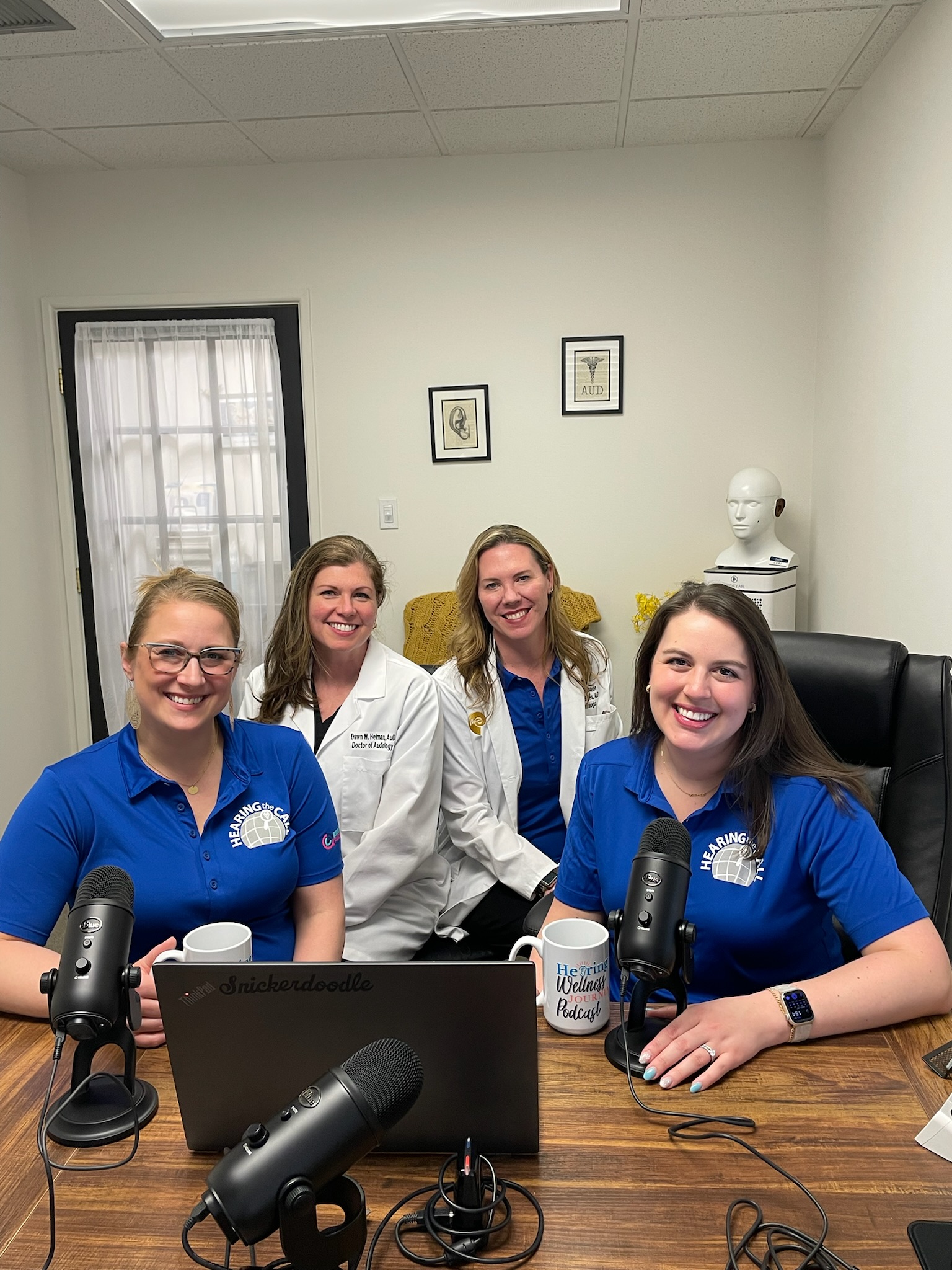
A hearing test can feel overwhelming once you’re home, staring at a graph full of symbols and numbers. In this episode of the Hearing Wellness Journey Podcast, Dr. Dawn Heiman, Dr. Emily Johnson, and Lindsey Doherty walk through how to read a hearing test step by step, using on-screen visuals and live screen sharing to make everything easier to understand.
Important note: This episode frequently references visuals, including a sample audiogram. If you’re listening on audio only, watching the YouTube video will significantly improve understanding.
How to Read a Hearing Test Graph (Audiogram Basics)
Using a shared audiogram on screen, the doctors explain how hearing tests measure volume (decibels) on the vertical axis and pitch (frequency) on the horizontal axis. Low pitches sit on the left, high pitches on the right. Red circles represent the right ear, and blue Xs represent the left ear—details that are much easier to follow visually during the screen share.
Dr. Heiman uses a “swimming pool” analogy to explain hearing loss severity: the shallow end represents easier listening, while deeper areas require more effort just to keep your head above water.
Why Hearing Loss Isn’t About Percentages
Many patients leave thinking they have “80% hearing” in one ear or “30% hearing” in the other. This episode clarifies why hearing tests don’t work that way. Instead, audiologists evaluate patterns where hearing drops off, which sounds are missing, and how that impacts clarity, not just loudness.
Speech Testing and Listening Effort
A major visual moment in the episode shows how speech testing works differently from tone testing. Word recognition scores measure how well the brain understands speech when it’s loud enough, not how people talk in real life.
Dr. Johnson explains why people often say, “I can hear you, but I can’t understand you.” Dr. Heiman highlights how relying on context, facial cues, and guessing increases listening effort, which can be mentally exhausting over time, something many people recognized during widespread mask use.
Why Audiologists Look at the Whole Puzzle
Using visuals, the hosts show how air conduction and bone conduction results reveal whether hearing loss is sensorineural, conductive, or mixed. Temporary issues like earwax or fluid can dramatically change results, which is why professional interpretation matters.
Every hearing test tells a story, but only when it’s explained in context, with your lifestyle and communication needs in mind.
To see the video edition of this episode with closed captioning, please go to Hearing Wellness Journey Podcast: https://hearingwellnessjourney.com/podcast/
TRANSCRIPT
===
What Does My Hearing Test Mean?
===
Dr. Dawn Heiman: [00:00:00] So it's more than just, "Let's take this hearing test result. Let's put it in an over-the-counter device. And you're just gonna work with it." The audiologist is piecing all this together for you and your family to create an ability to not only hear better, but to give you the strategies, because this seems simple, but all of this gives so much information to help you.
Narrator: Welcome to the Hearing Wellness Journey podcast, an exploration of determination, hope, self-discovery, and triumph. We'll share the personal experiences of those that are living with hearing loss and provide a haven for their stories to show others that they are not alone in this journey. Please welcome your hosts.
Lindsey Doherty: Welcome to today's episode of Hearing Wellness Journey podcast. I'm Lindsey Doherty.
Dr. Emily Johnson: I'm Dr. Emily Johnson.
Dr. Dawn Heiman: I'm Dr. Dawn Heiman.
Lindsey Doherty: And today we're gonna talk about: "What does your [00:01:00] hearing test mean?" As you're at home and might have questions.
Dr. Emily Johnson: I feel like that's a million-dollar question of, "Yeah, they went through it during my appointment," to get home, and then you look at it, and you're like, "Ooh, I don't think I fully understand what this means."
Dr. Dawn Heiman: Yeah. They're like, "I heard everything that they presented to me, and I don't believe these test results." Or some people, they just don't understand and they say, "I think I heard them say I have, 80% hearing in one ear and 20% in the other, something like that." And we don't go into percentages.
So we're gonna make it easier for you. And Dr. Frank Lin at Johns Hopkins University, about two, three years ago, came up with this Hearing Number that they were wondering if it would just be easier for people to be able to compare their Hearing Numbers.
So we can talk about that too.
Dr. Emily Johnson: Absolutely. But we're still in that traditional world of labeling things [00:02:00] in severity ranges. And I think it's important to remember that everything is a range. That there's a lower end of the range and a higher end of the range. Just like your annual blood work, you wanna be in those certain ranges.
And so when you get home, you're gonna have a sheet of paper or an email, something that looks like this.
It should have a graph on it. If it doesn't have a graph, it might have a table of numbers. That's okay. We're gonna go through what it means, so it's a little bit less intimidating when you are looking at your results.
So on the graph, up here on the -10, we're looking at your hearing level in decibels, and that is: how loud did the sound have to be before you raised your hand, pushed a button, whatever they had you do.
So you go from super, super soft sounds to really, really loud sounds, like a jet [00:03:00] plane taking off. And then from left to right, we're gonna look at frequency. So we're going really low, like 'ah,' 'eeh,' 'oh,' 'ooh,' all the way to those very, very high pitches and everything in between.
Your red circles are gonna be your right ear. The blue Xs are going to be your left ear. If you received a graph that is not color coded, do not panic. When it's a circle, it's your right ear. When it's an X, it's your left ear. So if everything is gray scale, or black and white, that's okay. X's and O's: it's standard. And over on the right here, you can see that there is a key.
So if you're ever unsure, it's going to list on the key what those symbols mean. And it's okay to reference back to that if you forget.
Dr. Dawn Heiman: Something that I tell people when they look at this graph: if you're going to dig a swimming pool in your backyard, [00:04:00] you can have a shallow end, and you have a deep end.
And, on this graph, if things are up towards the left, that's the shallow end. It's easy to stand in that water. It might even just be around your feet. There's no problem. But once you go into an area where they dug in deeper, in order to swim in that pool, you have to tread water. You have to work harder to keep your head above water.
So that's why we're testing the scale. To allow us to know: if you're struggling, why?
Dr. Emily Johnson: Absolutely. So our shallow end, here in these low pitches, 250 Hz to about 1000 Hz, is gonna be that shallow end of the pool. That is our lower frequency range, when we're talking about vowels and really low frequency, loud consonant sounds like 'duh.' 'Buh.' Very low frequency and pretty good volume [00:05:00] to them. I always say this is the volume of speech of where you have access to people talking.
When we get to those higher pitches, we start to dip into that mild, to moderate, to moderately-severe hearing loss in those high pitches. This is going to be where the consonants and the clarity parts of speech are.
So, I lovingly refer to this type of hearing loss as: "Everybody mumbles." Because you have good volume of speech, but when it comes down to, "Did they say fat, sat, or that?" Those are gonna be the sounds that you don't have complete access to, especially in the presence of background noise or if you're not directly facing the person.
You're relying heavily on context clues and other parts of a sentence that you can pick up. And you're using a lot of other executive functions to [00:06:00] fill in the gaps of what you are not taking in through your ears.
And that's exhausting at the end of the day.
Dr. Dawn Heiman: Yeah. Yeah. What do they say? Speech redundancies. If you can pick up on what someone says because you missed it. 'Cause we all miss stuff all the time. Someone said it incorrectly. They had food in their mouth or something. But you know the topic. And then you heard the context of the sentence. Maybe you heard the word or the sound just before the sound that you're missing. But it was enough for you to have enough redundancies or other cues to allow you to get the big picture. And to guess.
But yeah, guessing over time is exhausting. As the noise gets louder. Or someone starts to walk away from you, and their voice gets softer when they walk away, and they're not facing you. Or you can no longer see their lips because maybe you were using your eyes and your ears.
It's what we call listening effort. The listening effort increases when you are using extra [00:07:00] brain resources to figure out what someone's saying.
Dr. Emily Johnson: A lot of people realized how much listening effort they have to put in every day, and didn't realize how much they relied on visual cues until March, 2020, when the world started to wear masks.
Because this part of our face went away, people went, "Oh my gosh, my hearing is so much worse than I expected," or, "I'm struggling a lot more, I can't figure out why." We've removed this very crucial piece that helps us to fill in those gaps. And as soon as you don't have that, it's challenging.
Dr. Dawn Heiman: And then there were these plexiglass barriers in between you and the checkout person. You could have normal hearing. You're wearing a mask. They're wearing a mask. There's a piece of plexiglass between you.
You can't speech read. Some pitches, frequencies are not coming through. Maybe the high pitches are small enough that they kind of squeak their way around, [00:08:00] but the low pitches got blocked. Now, you don't hear the mumble, but you hear the other. And it's just...
understanding hearing is very complex. It's not: You hear. You don't hear. It is: What sounds hit your eardrum? In the string of sounds that come through very rapidly, with small gaps in between, you're supposed to know: That was a word. And that was a word. And that was a word.
It's exhausting to repeatedly say, "What? What?" And then, which person gives up first? The person that has to repeat themselves? Or the person that says, "I'm tired of saying what?" That's where arguments come in.
Yeah.
Dr. Emily Johnson: Hearing loss configuration comes in many different shapes and sizes. And this is just one example to hopefully give you at least enough information to be able to interpret your own audiogram [00:09:00] in the future.
When we look at your hearing, we're gonna look at it in several different ways.
So again, if we look over to this key and we see AC unmasked, or AC and BC. AC is going to be air conduction. That is going to be when people are testing your hearing through headphones, whether that be the kind that goes over the ear and makes you look like a pilot or the kind that go into your ear that are soft and squishy. Both of those are air conduction tests.
BC is bone conduction, and so that's when we put that little headband on. It sits right behind your ear, and that's going to bypass your outer, which is your ear canal, and middle, which is your eardrum and middle ear space, and go directly to the cochlea, which is your sensory organ of hearing, and then further on the pathway.
So looking at the graph here, when you see the brackets, that's going to be your bone conduction, and then the [00:10:00] X's and the O's are your air conduction. When those line up, we're going to call it a sensorineural hearing loss, meaning that your outer and middle ear components are all normal or not interfering and causing a gap between your sensory organ of hearing and testing it through headphones.
Dr. Dawn Heiman: And that's the most common type.
Dr. Emily Johnson: Absolutely. That's for 99% of people going to be the permanent type of hearing loss.
Dr. Dawn Heiman: Even though it sounds really bad, that is the typical type of hearing disorder that we see. A sensorineural hearing koss.
Dr. Emily Johnson: Yep.
Dr. Dawn Heiman: It's at the nerve level.
Dr. Emily Johnson: Yeah. So, when there is a gap, if we had the brackets much higher on the graph, meaning you responded to the sounds to the headband at a much softer level than through [00:11:00] headphones or earphones, that would mean a conductive hearing loss. That sound isn't being transferred the way that it should be through the outer or middle part of your ear, and if you bypass that, it's much better.
So that would be like if you have fluid in your ears, that's a very common one that people think about.
Lindsey Doherty: Yes.
Dr. Dawn Heiman: What's the number one thing that people call about, that they think they need their hearing aids bumped up? Or they say, "It's just... I feel like something's changed." What's usually the occurrence that would cause a conductive hearing loss?
Lindsey Doherty: Wax!
Dr. Dawn Heiman: "What? Ear wax?"
Lindsey Doherty: "Ear wax?"
Dr. Dawn Heiman: Talk about 'in the nineties'... 95% of the time, if your hearing has changed, it's probably a temporary conductive hearing loss. You have a hearing loss, but then you put a hearing loss on top because something's blocked.
Dr. Emily Johnson: Mm-hmm.
Dr. Dawn Heiman: Or, people come back from vacations, they can't hear as well as they used to. They're all full of fluid. Conductive hearing losses are usually temporary. It [00:12:00] adds onto what you already have. So if you have normal hearing, it's a conductive hearing loss, if you have normal hearing at the inner ear.
If you have a hearing loss, sensorineural, and then you add that temporary part, now we call it mixed. And then there's some people that are born with that, what we call airbone gap.
If we see a difference between your inner ear and your outer ear, we're gonna make sure we send you to the next level. We're gonna send you to a surgeon that's going to see if there's anything surgically that could be done to improve that.
Dr. Emily Johnson: Yep. Or sometimes it's a watch and wait.
Dr. Dawn Heiman: Yeah.
Dr. Emily Johnson: So if you look at your results, and you see that you have a difference between your bone conduction and your air conduction, if it's fluid from like a traditional ear infection, sometimes that fluid clears up on its own.
We just need our draining system to kick in. It drains. It goes away. And that [00:13:00] airborne gap closes. So you may not need any intervention for that time. But if it lingers or if it's a bigger problem, which is why we'll refer you to an otolaryngologist, then they might have some different options for you to see what we can do to close that gap.
Back to the testing. You are not only being tested with beeps. Because, believe it or not, we're not robots, and we don't communicate with 'beep, boop, beep boop' all day, though some days I feel like maybe my brain does function that way.
Dr. Dawn Heiman: Simpler that way.
Dr. Emily Johnson: Sometimes it's just one of those days you're like, "Ah, I just think I'm hearing beeps today."
But we look at speech. And speech is important, because that's how we communicate. That's more simulated to real life, than just: softest sound you can hear.
Dr. Dawn Heiman: Yeah, true.
Dr. Emily Johnson: So, when we look at speech the [00:14:00] first way, most often, is going to be a speech reception threshold. So this is going to be repeating compound words back to us, like 'baseball,' 'ice cream,' 'hot dog.' Depending on how hungry I am, will depend on how many food words you get presented. And we'll...
Dr. Dawn Heiman: You know what I think of when I do that list? Imagine a three year old's birthday party at a playground. We have ice cream, popcorn, paper airplanes or an airplane overhead. We have a cowboy that comes in. The baseballs that are flying.
Lindsey Doherty: Outside at daybreak.
Dr. Dawn Heiman: Well, daybreak... anyway, I digress. They're easy, children's words. Two syllables.
Dr. Emily Johnson: Easy words!
Dr. Dawn Heiman: It's not right or wrong. It's just: How low can you go?
Lindsey Doherty: They're having trouble in conversation with TV and the like. Right.
Dr. Dawn Heiman: Mumblers, having problems with certain people. Can't do it. Why?
Dr. Emily Johnson: The first one is going to be: Let's find a threshold. [00:15:00] What are words that you can repeat back that you're familiar with 50% of the time? So that's gonna be down on the lower right. Speech Audiometry portion under the SRT. That's what that means.
Word recognition is going to be: single-syllable words at a consistent level. This could be presented at your most comfortable level or louder than that, depending on your personal preference. The key here is we wanna make sure that you have good access to those sounds. We wanna see: what does your brain do when audibility is not an issue? Meaning you can hear it, does your brain understand it?
And this is where we tend to see people reference back to, "Oh, I have, you know, 96% hearing in my right ear, and 92% hearing [00:16:00] in my left ear."
Dr. Dawn Heiman: Er...
Dr. Emily Johnson: Not really!
Dr. Dawn Heiman: Or we say it's 32% and it's 48%, and they're like, "I don't feel like it's that bad." So let's go into what this test really is, why we do it, and how it's sometimes not fair. And other times it's... we have to test several things to, again, try to piece together why you're struggling.
Lindsey Doherty: The big picture.
Dr. Dawn Heiman: Yeah.
Dr. Emily Johnson: So, word recognition is presented at an audible level, meaning that you have good access to the different parts of speech, and we wanna see what your brain does with it. And this is going to be the man who says, "Say the word cat. Say the word ball." And you just repeat back the last word that he says.
This is going to be without context and no familiarization, which means that we are heavily relying on your brain to hear the individual speech sounds, put them all together, and formulate a common word. This [00:17:00] is going to tell us if we make things loud enough, usually through the results of hearing aids: How much do we fully expect your brain to at least have some sort of understanding of speech and language?
When this number is really good, in the 80+, that's great. Without context, no visual cues, no familiarization, your brain still has a pretty good ability to put together what words are being said.
When it starts to get lower, in that like 32% to 48% like Dr. Heiman just referenced, even when we make it loud enough that you can hear the individual speech sounds, it's still coming through a little bit distorted, and you're gonna need other inputs like context, visual cues, written materials if you're going into a meeting, so you have information prepared.
Dr. Dawn Heiman: [00:18:00] Right. Yeah.
Lindsey Doherty: Mm-hmm.
Dr. Dawn Heiman: It's not fair. It's not fair. Right? We're just like, "Say the word, ball. Say the word bad. Say the word cat. Say the word that." You know? Out of nowhere. No one just says the word and says it to you, and then stands there and expects you to know exactly what they said.
Lindsey Doherty: Right.
Dr. Dawn Heiman: Right? That's not the real world. It is a struggle for a lot of people, especially as their ears break. Maybe it was an autoimmune disorder. There was some kind of chemical change due to a medication. Something happened.
And then we're like, "Look, we know it's bad. But watch this. What if we put two ears together? What if suddenly you could see that man's face? Oh my gosh. That's a game changer. What if we said we're gonna talk about a baseball game?" Then you have an idea. All these words are about something. And then what if he actually said it in a sentence? What if he said it in a paragraph? You're gonna be doing gangbusters, great.
But the key here is that she was saying it's at an audible level. We make it loud enough for you to hear the sounds. When you speak to normal people, they're not [00:19:00] necessarily making their voice at a level that's enough for you because they have no idea how bad it is.
Dr. Emily Johnson: Right.
Dr. Dawn Heiman: We look at people all the time, and they walk in, and we're like, "You look like a regular Joe or Jane."
When we see the audiogram, we go, "Ohhhh." And if you bring someone with you to the appointment, which we usually recommend, because whatever happens to you affects your significant other, your family and all that. But suddenly we're like, "He can't hear you talk at this level." And they're like, "What?" And we're like, "No, we're looking. We know. Now, we know. And we're telling you, bring up your voice."
So, this is where we're trying to figure out if it's this loud, how good is it? Then we put the hearing aids on, and everybody else gets to talk at their normal level. And we have an idea, if you only get 32% 'in quiet' in the sound booth, that might be as good as it gets if someone just starts talking outta nowhere. If we add in these other things, we know that could be better.
So it's more than just, "Let's take this hearing test result. Let's put it in [00:20:00] an over-the-counter device. And you're just gonna work with it." The audiologist is piecing all this together for you and your family to create an ability to not only hear better, but to give you the strategies, because this seems simple, but all of this gives so much information to help you.
Dr. Emily Johnson: Absolutely. It's a puzzle. There are many pieces. They all go together. If we have four patients who come in with this exact same result, all four of them may report different levels of difficulty they're experiencing in their everyday life.
Lindsey Doherty: Yep.
Dr. Dawn Heiman: Absolutely. You and your life and your lifestyle depicts how successful you will be, or how our counseling will help you and give you strategies to meet your goals. So it's all about you and your goals, but right now we first have to just find out: How bad is it? It's like being an accountant, and someone's like, "I'm afraid [00:21:00] to show anyone my books. I think I'm going bankrupt." Well, if you don't, open it up and be vulnerable. We can't help you.
So this is why a lot of people are stressed to come into the office, to come into the booth, to have this done, because they don't wanna know. But we're telling you it's gonna be okay, and we're gonna keep it private, but we need to know how bad it is so we can make your life easier, so you have less listening effort.
Dr. Emily Johnson: Absolutely. And I mean, Lindsey can attest to this: How many patients have come in, they've seen any one of us, they see her, and they're like, "Yeah, I wish I had done this sooner," or, "I didn't realize how bad it was until I got hearing aids."
Lindsey Doherty: Yep.
Dr. Emily Johnson: And Lindsay has these excellent relationships with a lot of these patients who have been here a long time with Dr. Heiman as well. And they're like, "Yeah, the next set is just better than the last." And [00:22:00] I don't have a lot of patients who come in and say, "Yeah, wish I had waited five to seven more years before I did this."
Dr. Dawn Heiman: No, because it's not stagnant. Fortunately, unfortunately, they know Lindsay really well. Sometimes we see that hearing continue to decline. Or there's some cognition that has changed as well. And so that next pair of hearing aids, because the other ones - they were used really well; they were loved; they were worn every single day for eight years - and unfortunately they're breaking. But that next pair, you might be a different person. You've evolved into someone who maybe did move to a different area. Things are noisier. Or you need more cognitive resources to do the same job of just having a conversation with a loved one.
Knowing all those nuances, all of us, we look at the audiogram, or we look at the notes real quick, and we "Go, okay, I know what to do." Especially Lindsey, she's like, "Oh, you know, I feel like something's changed. We need to retest you. I can tell. [00:23:00] This is harder than it used to be. We know who you are, and this wasn't you. We need to figure this out." We're always problem-solving. That's all we do. Talk about a puzzle. This is good fun for us, though. We love...
Dr. Emily Johnson: It really is.
Dr. Dawn Heiman: ...to be able to figure it out for you, because it's not black and white. I hear. I don't hear.
Dr. Emily Johnson: Absolutely.
Lindsey Doherty: So many layers to that onion.
Dr. Dawn Heiman: Yeah.
Dr. Emily Johnson: So, we hope that you found this explanation of the audiogram and the results from your hearing test beneficial. There is absolutely no shame in reaching back out if you're like, "Can you go through my personal one again?"
Dr. Dawn Heiman: Yeah!
Dr. Emily Johnson: Just to have a better understanding. Or, you know, as Dr. Heiman mentioned before, that communication partner, that family member that maybe couldn't make your appointment and they're like, "I have some questions about the hearing test." We would be happy to go through that with them as well so that everybody is on the same page, because [00:24:00] it is your right as a patient and as a consumer to have a firm understanding of what your results mean.
So if you're not sure, if you wanna talk about it, go ahead and reach out to us. And if we are not your managing audiology team, go ahead and reach out to your managing audiology team and have them walk through your results with you, so that you can have a firm understanding of what is going on with your ears, your hearing, and your healthcare.
Lindsey Doherty: That's right.
Dr. Dawn Heiman: Sounds like a plan. All right. Till next time.
Dr. Emily Johnson: Thank you so much for listening today, and we hope that you join us for previous episodes if you haven't heard them yet or future episodes to never miss out on the information we are sharing. I hope that you have a wonderful rest of your day.
Dr. Dawn Heiman: Bye!
Dr. Emily Johnson: Bye!
Lindsey Doherty: Bye!
Narrator: Thank you for joining us on this episode of the Hearing Wellness Journey podcast. For more information [00:25:00] about what we do and the services we provide, please visit our website at HearingWellnessJourney.com/podcast, where you can find more resources based on today's discussion, as well as request to be a member of our Hearing Wellness Journey community on Facebook. That's available for our listeners exclusively on HearingWellnessJourney.com/podcast.
Resources Mentioned:
Our Mission:
Our Hosts
We are blessed with the opportunity to help people every day who have varying degrees of hearing loss and hearing disorders. We moderate this podcast to give you the ability to listen in on others' stories of triumph and perseverance.
Stay Connected
Never miss a podcast update, webinar or the latest news
We do not share any personal information with third parties.
CHECK OUT OUR
Resources
Advanced Audiology Consultants
Our Team of Audiologists are located in Oak Brook, Illinois and are here to help you hear.
EntreAudiology
Practice Locator
Need a recommendation for a qualified audiologist? We have a practice locator to help you find a reputable practice.
Hearing Aide Certification Online Course
Teaching nurses, CNA's, and caregivers how to help assist someone who wears hearing aids.
Hearing Wellness Journey Aural Rehab Course
Teaching you everything you need to be as successful as possible with your hearing aids with a series of videos.
Contact Us
Would you like to be a part of our podcast?
We welcome you to share your story too!